Transportation in Istanbul
There are three main options for transportation in the city: by car, by taxi or by public transport.
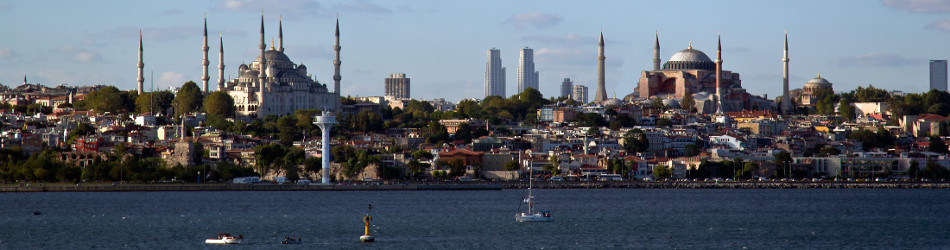
No matter which transportation option you choose, your experience is going to be shaped by the fact that the city is placed across two continents: an European side and an Asian side, with the Bosphorus strait in-between.
By car
An important issue when traveling by car is related to finding an accessible parking spot. If you're staying at a hotel, consider asking for a parking space as part of the reservation procedures.
There are three bridges across the strait (the third one, Yavuz Sultan Selim, opened in 2016 far to the north), plus the Eurasia road tunnel under the Bosphorus. On the two city-centre bridges there is no charge when traveling from Asia to Europe, just for the reverse direction (from Europe to Asia).
No cash payment is allowed on the bridge and tunnel tolls: cars need an HGS electronic toll sticker, which rental cars usually already have.
By taxi
Taxis are fairly expensive. While they might be ok for a short distance up to 2-3 km, longer rides add up quickly, especially in heavy traffic. Make sure the meter is running. Unless in an extreme hurry, public transportation offers a better value.
By public transportation
The public system in Istanbul uses an integrated payment system based on Istanbul Card. It is a credit-card-sized device which is essential for paying around in the public transportation system.
The card can be bought either from the ticket vending machines found at most metro, tram and ferry stations, or from kiosks run by private sellers, which usually charge a little extra for it.
Once you have a card, keep enough balance on it for several rides, as fares are raised frequently. If you run out of credit, the reader will make a strange sound which can put you in a difficult situation, especially if you don't know the language. Top-up machines are available at most popular stations - you need to put the card on the machine, insert the banknotes and then pick it back up.
You can now use this card whenever you take a tram, bus, train or boat. To pay for it just put the card near the wireless payment reader system. In 1-2 seconds you'll hear a specific sound and then you're done! Please note that if you take a bus, you need to get in it only via the first bus door (next to the driver).
If you don't have a card, you'll need to buy a single-use or limited-use ticket from the same vending machines, which costs noticeably more per ride than paying with the Istanbul card.
In addition, the card system gives you automatically discounts if you're taking 2 or more transportation systems within a period of 2 hours (e.g. a tram followed by a boat).
If you're travelling in a group of 2 or more persons, you can use a single Istanbul card to pay repeatedly for all members of the group. In this case please note that the 2-hour multiple-trip discount is only offered for the first person using the card. If you want to obtain it for every group member, each person needs to have its own card.
Often you'll need to switch between the European side and the Asian side, and the most enjoyable and cost-effective way to do this is to take a boat trip. Avoid the touts selling private "Bosphorus tours", as many of them charge tourists hefty sums of money for the privilege. The Sehir Hatlari city ferries cost about the same as a metro ride and can be paid with the Istanbul card.
If necessary, download and print in advance an Istanbul transportation map. On the European side, the most important boat docks are Kabatas, Karakoy and Eminonu, and on the Asian side the most important ones are Uskudar and Kadikoy. The latter also has a close-by Starbucks you can visit for a refreshing taste of the coffee you're accustomed to (if that's the case). Take a look on the map to become familiar with each one of them and see which one is closest to the location where you're staying.

To and from the airports
Istanbul has two main airports: Istanbul Airport, on the European side, and Sabiha Gokcen on the Asian side. First check on what side is your hotel located. If you're landing in one continent but staying in the other, you'll need to pass the strait as you travel from the airport to your hotel.
Sabiha Gokcen
This airport is located about 40 kilometers (60 minutes) from the city center. Since 2022 the M4 metro line runs from the airport to Kadikoy, and you can pay for it with the Istanbul card. The Havabus buses (formerly Havatas) offer two routes: one travelling to Taksim, for those staying on the European side of the city, and one travelling to Kadikoy for those staying on the Asian side.
If you don't have any local currency, use one of the ATMs found in the airport before leaving. Please notice that you won't be able to return inside the airport via the same gate once you leave, as it's Exit-only.
Istanbul Airport
Opened in 2018, it replaced Ataturk Airport for passenger flights in 2019. It is located about 40 kilometers north of the city center, on the European side. The M11 metro line connects it to the city's public transportation network, so you can pay with the Istanbul card, and Havaist buses run to Taksim and other central districts. You can review the airport's official site for the transportation options you have at your disposal.
Marmaray Tunnel
Inaugurated in 2013, Marmaray is, in addition to bridges and boats, a new way to cross the Bosphorus strait - by going underground!
If you want to try it out you can take those trains from either Sirkeci (on the European side) or Uskudar (on the Asian side). The tickets can be paid using the Istanbul Card system.
The trains are reaching 60 meters depth (55 meters of sea and 4.6 meters of ground below the sea). The tunnel is earthquake-resistant, and since 2019 the full commuter line runs for about 76 km between Gebze and Halkali.
Prince Islands
If you're in Istanbul we recommend at least one visit to the Prince Islands. Available by boat in 60-90 minutes time, they give the opportunity to observe the Marmara sea, panoramic views and clean air (as private cars are banned on all islands; only small electric vehicles serve them).
The city ferries to the islands can be paid using the Istanbul card system. To board, use the Kabatas port on the European side of the city, or Kadikoy on the Asian side.
The biggest island, Buyukada, is the last (4th) stop. It features quite a large surface, but bikes are available for rental and a bike-tour of the island is feasible for most tourists that are willing to try it out.
Kinaliada is smaller in size (1st stop). If you want to try a tour by foot, this would be the most suitable first attempt to do so.
Don't forget to check upon arrival when the latest return boat departs, as you don't want to remain stranded on the islands (hostels are nice but can be expensive and mess with your schedule especially if you didn't come prepared for that).
Country: Turkey
City area: 5343 km2
Website: www.istanbul.gov.tr
Transportation
Comprehensive Istanbul transportation guide on how to get around in the city.
Temperatures (in oC):